Saturday, 25 February 2023

BOGUK gets Needled

I started this badge a few times, but have finally done enough to call it finished, I think. It's slightly heavy on the Christmas theme, but I hope that doesn't matter. I did the following clauses:

Clause 4 - Embroidered a sampler, card, picture or similar using counted cross stitch.


This little bear was a kit on a magazine, and it isn't obvious but the snow flakes and parts of the scarf use a metallic thread. It was an interesting challenge getting it situated to the cut out, but I'm quite pleased that I managed it.

Clause 5 - Embroider a sampler, card, picture or similar using blackwork embroidery.


This is about 8x8 inches, and I do love the art deco effect that it has. It's one of my favourite things about blackwork, that particular aesthetic is a common one for this style of embroidery.

Clause 6 - Embroider a sampler, card, picture or similar using Hardanger embroidery.


This was new to me, and I found it quite hard to do the cutting, and it has ended up looking a little tatty on the edges. I don't think I'll be taking this up as a style of embroidery, but I enjoyed this taster.

Clause 7 - Embroider a sampler, card, picture or similar that incorporates beadwork.


Whilst I've done things with beadwork before, I did get to try something new with the perforated paper this is worked on. Although the tiniest beads which have a full cross stitch through them were a bit of a pain, and not all of them could fit the needle through twice. Luckily the kit came with plenty of beads.

Clause ? - Embroider a sampler, card, picture or similar using Sashiko embroidery.


This Japanese embroidery technique was new to me, and whilst it isn't an existing clause, I'm sure this should count, as this is a completely different style to anything else I had done. The fabric is folded onto the needle and then it is stretched out to give the running stitch. I've fallen in love with this technique from the portability point of view, as the traditional fabric for this is so forgiving of being folded, screwed up and generally treated badly, and it turns out good at the end. Expect to see more of this from me in the future.

Tuesday, 27 December 2022

BOGUK in Stitches

 This is going to be a hard one to write up, especially as I know I don’t have the photos to show some of it.

Clause 1

I have just finished adding my 2019 badges to my blanket, and I need to sort out my next one now. I’ve added plenty of badges, with different styles of adding. From my usual behaviour for badges, to blanket stitching on shaped ones, and just some stitches to hold on ones that were sticky backed. I was really annoyed by one sticky badge, it gunked the needle so quickly I could only do about 2 stitches before needing to clean it off. Luckily, the hand gel I used cleaned the needle quickly and easily. Although the photos are a mix of 2019 and 2018.


It’s been a while since I’ve sewn on any buttons to anything, but then, I had a habit of sewing 4-hole ones on so well that the button went instead of the thread. Eventually I learned to be looser in the stitching, and in my wrapping behind the button. Usually I go for about three or five iterations of going though holes and then wrapping, depending on he number of holes, quality of thread, position of the button etc. It’s been so long since I’ve seen or needed to sew on a button, I have no photos.

Clause 2

I now have two sewing machines, one decent singer, and one light and easily carried which will even run off batteries. Both are similar, but different, and similar to the ones I knew best in the past.

Both have the ability to wind a bobbin with a simple switch. For the decent one, the bobbin threaded into a holder and put under the foot from the front. The other loads down rather than from the front.

Needles are replaced by undoing the appropriate screw and changing it over, I’ve done this on the decent one, I’ve not used the portable one enough yet to need to do so. Feet these days are all generally easy change, and you just clip them in and out. It’s even more fun figuring out which foot to use for what…

Both have pedals to control the speed, and so I use the pedals (the portable one doesn’t have to use the pedal), and reversing is done at a touch of the appropriate button.

Tension and thread length are easily altered on both, by moving dials to the appropriate places. The available variations are far more limited on the portable one.

The one thing that is true for any sewing machine, is to read the manual, all this information is usually there.


Clause 3

The main difference is simply the source of the fibre, and the types of fibres available now are so varied. If you want something for warmth then wool is a good bet, with some natural wools being softer than others, and some synthetic wools being easier to work. Natural fibres tend to be woven, and less stretchy in the basic weave. Where weaves are looser, then heat (either for the water or drying temperature) can shrink an article, which is why you should prewash items such as cottons before using them. Synthetics are often stretchier. However, laundering is at least slightly nuanced based on the material and the weave, however, in a simple approach, natural fibres should be washed cool and dried in air, whilst manmade items can be washed hot and dried mechanically.

Theoretically you can use whatever you like to make anything, but that often isn’t a wise approach for practicality. Underwear made from Welsh wool would not strike me as a good idea, it was itchy enough as a school tie. However, a woven polyamide may be smooth and comfy against the skin, but it would make an awful coat. If making a dance costume, something with a lot of elastane is usually a good choice, especially if it stretches in both directions. Choosing the right fabric will always depend on the garment usage, as well as wether it needs to be waterproof, how it needs to drape or flow. It can also be useful to consider the needs of the person wearing it, as some people can react to some fabrics.

Thread and findings usually need to match in specific ways. It’s always good to match colours, but it is also important to match elasticity. Using a rigid thread with elastic fabric will lose the benefit of the elasticity to some extent, and the fabric will pull away from it potentially. An elastic thread will not hold a rigid fabric well enough, and again the seams will not behave correctly.

Optional Clauses

Clause 4

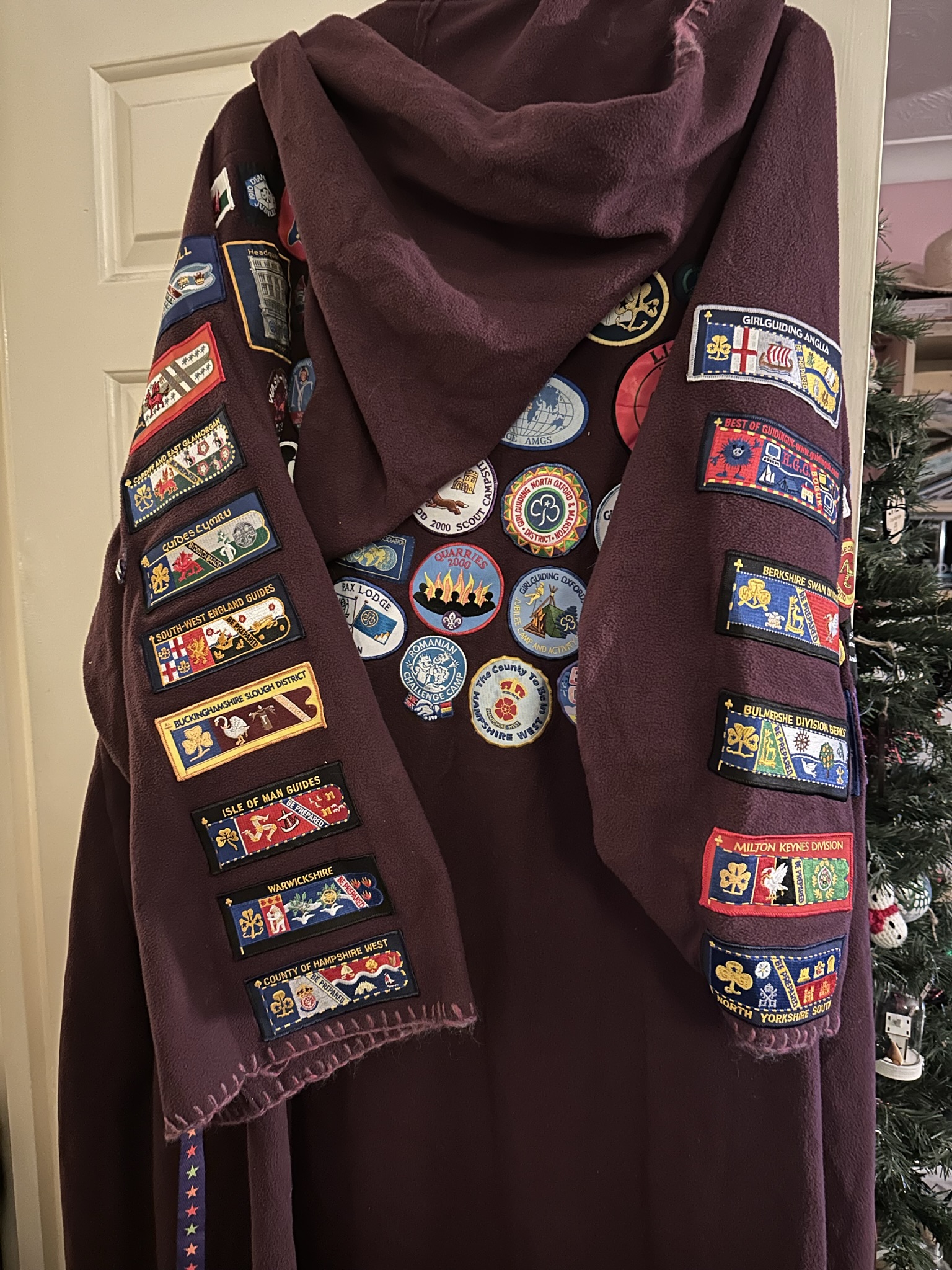
I used a pattern to make my campfire robe. I’ve started adding badges, but having cut it and sewn it (with arms, hood, and yoke), I then blanket stitched the edges, and added a clasp, and some ties that would allow me to keep the sleeves away from my hands if I need to.


Clause 10

I made a set of Christmas decorations and gave them to friends and family using English Paper Piecing patchwork techniques, the only thing I didn’t do was remove the ‘paper’ in the middle, in fact I used card to create something rigid as they were meant to be tree decorations. I did some ‘fussy’ cutting to get one patch as I wanted it, and got some definite compliments for the quality of my stitching from some folks.


Clause 12

I hope it counts, but I did make a number of masks in various patterns, which were very useful over the last few years, and a little more complicated than a cushion cover.


If anyone has any doubts about any of the optional clauses, then maybe the bunting I made for the Foxlease Centenary makes up for it. This was hand sewn, as that seemed the best bet with the electronics!


Friday, 16 December 2022

BOGUK is a Bookworm

I've started, and re-started this badge a few times, I kept my notes better this time. Then, when I went to double check the syllabus, I realised that it was now shorter, and I've completed it!

Clause 1

I’ve specifically read 12 books, and I probably won’t copy out all my notes necessarily, but here are the ones I’m counting.
- The Sign of Four, Doyle (Classic) - very much of its time, and it could do with encountering some equality…
- A Discovery of Witches, Harkness (Series) - it was an intriguing start to the series
- Shadow of the Night, Harkness (Series) - the parallels and echoes between the historic and modern sections were nice
- The Book of Life, Harkness (Series) - a reasonable conclusion, but jumped around a lot to try and fit everything in
- Breakers of the Dawn, Wahrer (Science-Fiction) - closer to high fantasy than SF, and OK, but not innovative enough to carry on with the series
- Pretty Girls Dancing, Brant (Crime, Thriller or Horror) - no real surprise in the ending, but it was a good read
- The Grid, Teague (Young Adult) - derivative, but well written enough to leave me wanting to find out what happens next
- Otherworld, Segal and Miller (Science-Fiction) - the concept was good, and it would make good TV
- Hero in a Halfling, Tyler Davies (Fantasy) - this was horrendously derivative, it seemed to be trying to do what Wayne-Jones, Gaiman, Pritchett, etc. have done well, but it didn’t do it for me
- Brilliant Agile Project Management, Cole and Scotcher (Non-Fiction) - a nice overview of the methodology
- The Bullet Journal Method, Carroll (Non-Fiction) - this took me a while to complete, but has had a good impact on my own bullet journaling techniques
- The Mersey Sound, Henri, McGough, and Patten (Poetry) -  my favourites were the McGough section, but I think it is fair to say that he is my favourite poet

Clause 2

I have read A Christmas Carol (Dickens), which is so much a part of the zeitgeist that there are many many adaptations.
The most recent adaptation I saw was in person at the Bridge Theatre in December 2022. This was the adaptation by Nicholas Hytner.
It uses a lot of the text directly, but with a cast of just 3 it had to diverge at times.
A good number of the ‘visions’ were done via narration, and the responses of the performers to what they could ‘see’, but the audience could not. Whilst that was likely due to the limited number in the cast (it was originally conceived and ran in 2020) it allowed the audience to join in the imagination aspects. This was especially impactful for a section, usually missed out, where the young Scrooge at school sees characters from stories come to visit.
This was a very true to the text adaptation, and the theatrics were excellent.

(Aside - I now realise just how true to the text most adaptations are, and especially the version by the Muppets!)

Clause 3


Poetry is of course subjective, and what I find good others will hate. I feel like I’ve timed my reading of this wrong, I’m too old for some of the poems to be vital, and too young to have heard most of the authors voices (if you get a chance do see Roger McGough). Much of what in contained in this book is timeless, I’m reading it well after the 50 year reprint and it still reads as the world today is, with the caveat that without the mass media and technology the imagery is firmly rooted in a smaller world than they may (or do) write about now.

Sunday, 7 June 2020

BOGUK the Campfire Singer

Having just had a virtual Foxlease Singing Circle weekend, and before I put my books away, I felt it wise to have a look at this badge, and with just the one clause left to do, I thought there is no time like the present!

The required item of participating it or running 3 campfires, one of which should be outdoors:

So, I have been singing for most of my Guiding story, and since I first declared this badge I have taken part in lots of campfires, I just didn't necessarily record them all. 
The unit I'm with had, and still has, a tradition of singing around small fires at a meeting night periodically, so those are some real fires and outdoors. For the other two, I'm going to highlight a specific couple that have meaning for me at the moment. 
Like a lot of others, I took part in the WAGGGS Shine the Light campfire during lockdown, there are very few opportunities normally to share like that across all regions and all world centres, so it was certainly an experience. 
I also want to highlight the one I ran, you'll see it come up in the other clauses too, about a year ago I found the courage to get up the front on a Saturday night and lead at Foxlease Singing Circle, it was one of the quietest weekends we'd had for a while - for which I was grateful. Whilst that is also covering a lot of my other clauses, please do not underestimate how daunting even a quiet weekend like that can be, there were still 60+ people in the room, many of whom have way more experience than I do at getting in front of groups, and they often refuse in that scenario to actually run/lead a session of any type, even the incredibly informal and friendly Saturday night. For me, that was a significant challenge, I still don't believe I can sing, and even when I think I can, I do not kid myself, I'm chorus and no soloist, so to try and lead those amazing women in song takes some courage. It also seemed to basically go OK, which is reassuring.

1. Develop and maintain a collection of campfire songs. Be aware of copyright. Understand how many songs have been handed down by tradition, and thus words or tunes may vary slightly across the country. Be aware of songs which may cause upset or controversy if used.

I have a wide collection of books by now, ranging from some I've acquired from others that are impossible to buy, to ones that have been produced recently. I have sheets of unpublished songs. I have an extensive collection by now. 
Copyright is usually detailed in books, which is helpful, but a number of the songs are old enough that they are not copyrighted either. That means, that I can't distribute songs which are copyrighted, and I shouldn't distribute the settings of songs in the books. 
Lots of songs are handed down, or written down from hearing someone else singing it, to the extent that sometimes you get a remembered copy of a recent song that can't be traced, gets published, and later the composer manages to get the correct version of the song published. People remember things differently and will, therefore, gain variations, especially if there are differences in dialects and similar. The general consensus is - the person leading has the final say on how it is sung! 
It isn't always easy to avoid controversy, sometimes you learn a song as a fun song, but there is a darkness behind it that isn't necessarily appropriate, or it plays on stereotypes that are inaccurate. Some songs are starting to fall into being frowned upon for others using them in certain situations as cultural appropriation - which I certainly understand, there is something unsettling hearing a song that is part of your culture sung in a different language or by people who are not from the same ethnicity. Sometimes you don't know until it is too late, at which point, apologise, and try to avoid the song next time you are leading - or explain the situation and share the reasoning with others.

2. Run a campfire for a group, to include at least one song from each of the following areas:
  • Action songs - Eidelweiss
  • Rounds or part songs - Campfires Burning in 5 parts (the 5th part stays silent to get a chance to hear the harmonies)
  • Quiet songs - Softly at the fall of day
  • Traditional songs - Barges (by now it is traditional!)
  • Songs that are new to the group - Robin Ddiog (if it wasn't new it's at least one that is sung very very rarely)
  • Non-singing items such as stories, sketches etc - I told the story of the great grey ghost elephant
I actually ran that Saturday night as a fairly formal campfire to make sure I got everything in, I've noted above at least one of the items I included that covers each of those sessions.

3. Be aware of safety at a Campfire. You should pay particular attention to the size of fire, and those responsible for keeping it going. Know what to do if a fire gets out of control, or a camp blanket catches fire.

The scouts have some reasonable instructions for fire safety (https://members.scouts.org.uk/documents/Chubb/redesignedresources/CFS2256%20Building%20Camp%20Fires%20Safely.pdf - accessed 7/6/2020), that are a good start. 
One big thing is to make sure you have fire and/or sand available, and multiple buckets of them if the fire will be bigger than a waste paper basket. 
I'd also aim to consider turfing if there isn't a formal circle and so that we can put things back as we found the, and to be aware of dry ground, as the heat can travel through dry ground to start a fire in unrelated spot. 
A fire should always be kept to a size you can control, that doesn't mean it has to be small - if you have a dedicated circle it can be quite large, just remember the larger the fire the longer it takes to go out. At one event we watched a fire door burn through on a campfire (it had been replaced so was in the wood pile), which was fascinating, but it took a long time. 
When leading a campfire, or when attending, the general rule is stay out of the way of the people looking after the fire, it is there's to take care of, and we should leave them to it. I'd also be inclined with a moderate or large number of participants to not have a full circle around the fire of singers, if they are a little more gathered it is easier to lead them, but also it provides somewhere to go if there is a problem. It's also worth remembering that in the dark, if the fire is behind you, then the singers won't be able to see your face, if you are behind a large fire, they won't be able to hear you. There is no easy answer to this, and each campfire is different, and it will depend on a lot of factors on the day. 
If the fire gets out of control then it becomes something to fight, not tend. Get the water/sand on it, get the singers away from it, and treat it as wild. 
If a camp blanket catches fire there are a few different options, mainly based on what you can do with it. If you can get it off the person easily - do so, then smother the flames, drop it in the bucket of water, whatever it takes. If it's a poncho or you can't seperate person from blanket, stop, drop and roll is going to be the best option. If it is wool, it might just laugh off sparks rather than catch fire, but a synthetic could start to melt - again, get it away from people if you can. You then need to start treating the blanlet owner for any potential burns and shock.

4. Take part in or lead a “formal” campfire, which is structured and follows a programme.

The campfire I lead in June 2019 was formal, and had a full programme, which I now can't find a copy of. Let's just say, I based it heavily on the Let's Sing manual by Guides New Zealand, with some variations for the extra songs, and the little sketches and songs that people were presenting.

Now onto the 4 optional clauses

5. Write a new song to an old tune, and teach it to a group.

It may be a stretch for teaching it, but I have shared a variation on the words to Linger with a few people, and they are below:

I want to linger (at a distance)

Hmmm I want to linger
Hmmm a little longer
Hmmm a little longer here with you

Hmmm though you are far away
Hmmm just recall each day
Hmmm that our friendship ignores miles

Hmmm though not together
Hmmm we are forever
Hmmm still Guiding sisters in our hearts

Hmmm and till we meet again
Hmmm though we know not when
Hmmm just think of me and find a smile

Hmmm I want to linger
Hmmm a little longer
Hmmm a little longer here with you

11. Sing a song in a foreign language.

There are a few songs I can sing in foreign languages, even more if you include Latin or Hebrew as a foreign language. Rosen Fra Fun is an easy one, I have sung Alouette (at the shine the light campfire most recently), Nada te turbe is a nice little Taize chant, Nkosi Sikelel'i Afrika is often sung by the singing circles.

14. Lead a campfire item which relies on rhythm, such as “Rain Storm” or a clapping rhythm.

In that hard-working session I lead in June 2019 I also lead rainstorm, and it worked really well with that number and group of people who actually watch what the leader is doing.

17. Plan a campfire on a particular theme (e.g. animals), using songs, sketches etc.

Giving that June campfire a break (there were more than 40 there, but...) I decided to write a fairly short plan for a campfire on a theme. As it was fairly short I included one little fun spoken verse that could easily be turned into a sketch. The theme is a rainbow, and I actually start with songs that feature the word red, going through to the sketch after a little wind-down and then trailing off into the purple at the end. I've used the shortened names of books that seem to be common with the Foxlease singing circle crowd, most of which are nicknames. 


ColourSong TitleBookPage NumberBookPage Number
Red/GoldTsoona Campfire OpeningCanadian Jubilee7
RedRed BalloonPax Lodge22
OrangeOh I wish I was little Or-i-engeMemory
YellowThe Village DanceCanadian Jubilee21
YellowBaby DuckMeet and Sing4
Red/Yellow/GreenThree Traffic LightsScottish57
GreenSomerset Walking SongYellow Chalet36
GreenThat's when I feel like singingEverybody Sing24
Five Little Crayonshttps://teachingmama.org/wp-content/uploads/2014/04/Screen-Shot-2018-07-23-at-3.10.24-PM.jpg
Blue/GreenCome with the eveningYellow Chalet78
BlueThe RoverYellow Chalet47
BlueO hark to the larkAll sorts19
BlueFollow the sunJust for you22
BlueThis pretty planetPax Lodge129
BlueLook up to the skySing for Joy28Songs for tomorrow14
Red/Green/BlueBargesYellow Chalet21Canadian Jubilee56
BlueLand of the Silver BirchYellow Chalet16Canadian Jubilee15
PurpleWild Mountain ThymeSongs for tomorrow21
PurpleHawaiian Fisherman's SongSongs for tomorrow22

Sunday, 31 May 2020

BOGUK On-Line

Most people for this will probably only do 8 clauses. I'm a bit too computer literate so I'm going to attempt to do as many of them as I can. There are a couple I will tweak, but I will address every single clause below.

  1. Get Online:
    1. Explore different ways to connect to the internet (e.g. home broadband provider, mobile data).
      A home broadband provider will give you internet access by connecting your home to their network, which is in turn connected to the rest of the internet. Most workplaces and educational establishments do the same. Mobile data has the data passed via your mobile phone signal. This can be fairly expensive. Whilst a home broadband connection is limited to geography - you have to be close to home, mobile data is more constrained by signal availability and strength.
    2. Find out where you can access public wi-fi hotspots in your area. Discuss the risks of using a public hotspot.
      It might almost be easier to list where I can't. Most coffee shops provide access, especially the big chain ones. Many of the supermarkets seem to. The local Arts Centre gives me access. My nearest library has a hotspot too. The biggest danger of using a public hotspot is that the connection is often open, meaning others can view what you're sharing over the internet there. The other thing to be wary of is that you are actually connecting to the hotspot you think you are, as all you have is a name, and possibly a password, it is very easy to connect to someone who is collecting data rather than the connection you mean to make.
  2. Stay Safe Online:
    1. Connect to the Girlguiding website at https://www.girlguiding.org.uk/, and read the pages on "Staying safe online" and "Risks and issues online".
      So those pages are out of date. There are now official group available that are looked after by headquarters. They also don't reflect the hopefully temporary physical distancing requirements that are currently in place for the UK, which has to lead to some different instructions and advice...
    2. Develop family and/or personal guidelines for use of online services and exploration of the Internet. Discuss issues such as costs, amount of use that is reasonable, parental guidance, shopping by computer, and safety on the Internet.
      Even before we got a worldwide pandemic that kept me home a lot more I would live mainly online, so my access is via a decent speed and unlimited. I don't share my connection with anyone, so my rules are only for myself. Typically these match to my ethics, if I think a site looks dodgy I don't go there. I try to be careful about what information I put where on line. When I'm out and about I had started using a VPN - see a later clause for more info.
    3. Visit the website https://www.thinkuknow.co.uk/ & read up on some of the current issues that relate to young people and online safety. Know some of the apps that young people are using today (make this relevant to an age group you are familiar with eg your own children, Guides if you are a Guide leader …)
      An interesting site, with a lot of good information. My only criticism would be that for youngsters it probably wouldn't be found. However, most of the advice is sound whatever your age.
    4. Find out about software designed to protect children from accessing unsuitable information on the Internet, such as Net Nanny. Does your broadband provider offer options to limit the sites that can be accessed using software, or other methods? Look at costs, ease of use and limitations. If possible, try them out. How effective are they? Do they hinder the "normal" use of the internet?
      I've never used anything that stops websites (adds, spamware etc. yes), but I have only myself to blame if I go to a website that I don't want to visit. As using a limiter would give me something else to maintain I won't use one. I'm also aware that given my employer, and that I'm a software engineer there can be times I need to go (or appear to go) off the beaten path in the wilds of the world wide web. My current provider supplies a solution that allows this, as did my previous one. Typically they replace the page you want to visit with a "here be dragons" type message...
    5. Explain what is meant by “catfishing” and the measures you take to protect yourself from this when online.
      Catfishing is the act of someone pretending to be someone else. Sometimes this can be for fun, sometimes it is for darker purposes. The best way to protect against this is to look for information that supports who they are and if the contact is from someone unexpected or unknown be careful of the interaction. The other thing to look out for here is someone spoofing the connection of an existing friend. If you get something like a Facebook friend request from someone you are already friends with the chances are that someone is trying to pretend to be them.
  3. Connect Online:
    1. If you are not already a member, join the BOGUK - Best of Guiding_UK Facebook group and take part in discussion in the group for at least three months, posting as often as possible (at least once a week).
      hmmm... I've been a member for a very long time, but I'm not sure I quite make the once a week for three months... I'd hope the fact that I've survived the move from yahoo groups to Facebook, and am still posting when I have something to say is enough commitment to the group
    2. Undertake a review of your Facebook privacy settings & ensure you understand how your information is used.
      I checked my profile as if I were public, and there was next to nothing visible that might not be findable by other means. I also discovered that you can now assign a friend to look after your account for memorialisation, I think I need to have a conversation with someone about that. I've already set up things like 2FA, and skimmed again the privacy policies
    3. Take part in a real time chat session with at least two other people, this could be text based or video based.
      Do I really have to find proof for this, I've chatted with a few people from this group in a few different ways, and spend most of my working life during lockdown in one VC or another...
  4. Find Information Online:
    1. Improve your use of key words when searching for information in a search engine. Find out if there are shortcuts to narrow the field of inquiry.
      I already use a number of tricks such as quotation marks for must includes, "-" for not including, using multiple words/phrases to get to my desired information.
    2. Use the internet to look for a specific piece of information that you previously have not looked for (e.g. the surface temperature of Saturn, Albert Einstein's birth date etc). How many solutions were presented? Compare the accuracy, and reliability of each one. Why are some sources considered more reliable than others? (e.g. some universities won't accept wikipedia as a source of information due to the way data there is maintained)
      As I don't work within astronomy or similar I'm going to look for the surface temperature of Saturn, I used the phrase "surface temperature" saturn for the search, and was returned 274,000 results in 0.53 seconds. The snippet at the top was from sciencing.com, which I have never heard of. Without looking into the source in detail I'll accept the results for this, interestingly Wikipedia was the third hit, but it was telling me instead about Titan (one Saturn's moons). The snippet at the top also echoed nicely into the scholastic hit, so I'm happy enough now about that information (and I'm still on the first page). It was actually page 3 before I got to a 'respected' science site (I'll take the information from Cern without too much consideration). The reason I'll respect that site is basically peer review. Wikipedia is easily edited and is open source, which means the information can be incorrect without anyone noticing. Whilst any other source can still be wrong, where it can't be edited by almost anyone it is a little more reliable than someone has made the effort to fact check. and the better known the organisation the higher the chance that they will get it right - it might take longer to get a request approved of misinformation corrected. However, depending on what you want the information for you can use a dubious source, or get a correlation between a number of sources to come up with a good answer to a question.
    • EITHER:
    • Investigate a variety of home broadband providers to find the one with the most suitable package for you. Are you happy to change your phone number? Do you need reliability? Do you need speed? Do you need lots of data? Are you looking purely for the cheapest? Compare costs and services offered. (Don't forget to include telephone costs as well!)
      I undertook this kind of search earlier this year, and I'm not willing to look again now. However, I can specify what I was looking for - I value speed and amount of data more than cost. Because I'm looking at heavy usage for bandwidth and want speed I can almost ignore the telephone aspect as most of the big brands throw those in for free. The costs are also fairly standard at that end of the market too, so it ends up being the added value that I looked for. As such I ended up selecting the same provides as my mobile contract, as the cost was similar enough to everyone else, but I got a little discount on both my mobile and broadband contract.
    • OR
    • Investigate a variety of mobile data providers to find the one with the most suitable package for you. Do you need reliability? Do you need speed? Do you need lots of data? Are you looking purely for the cheapest? What's the difference between 2G/3G/4G/5G? Which do you need? Which can you use where you live/work? Compare costs and services offered. Learn how to tether another device to your mobile to use that data instead of a wi-fi signal.
      Again, I did that fairly recently, so am not going to compare, but I will explain my priorities. I don't use my mobile broadband as much as my home broadband, but even during the 2020 lockdown I found myself using it, as sometimes the 4G connection through that was better for a VC than my wifi and landline connection. I was looking for price, unlimited data, and decent speeds in a lot of the UK, and ideally Europe at least (I travel for work and don't have a mobile provided by work). Because I wanted to allow for travel that immediately meant I'm looking at the international brands, but, as is often the case my phone was also part of my deal, so I hunted for the phone I wanted and a decent price, with lots of data and lots of call time. Typically that means I get lots of texts too. But again, my driving force is data, and it is really nice not to have to think about it sometimes.
  5. Carry out research on Guiding in another country using the Internet as your main research tool. Find activities, information and pictures. Use the information gained to create an International evening for a unit, or plan an International trip.
    As I had no idea which country to look for I asked Alexa to select a random country, and the system came back with Kuwait, so I will look into Kuwait. Starting at the WAGGGS page, I went to the regions, then the Arab region and then Kuwait, then to Find out more: https://www.wagggs.org/en/our-world/arab-region/member-organisations/kuwait/. This page gives me some Guiding facts, and as I'm a Guide leader I'd be inclined to do something like a guide laws quiz, is it ours, is it theirs, did I make it up? So The Girl Guide smiles in the face of trouble and faces it with patience and steadfastness (smiling). is a law in Kuwait, whilst The Girl Guide washes between her toes would be one I'd made up. My unit tend to like to move, so I'd probably play this as a game with one side of the room being 'ours', the other being 'thiers', and the middle being 'mine'. From there I'd start with a search more generally for things like maps and similar, and probably try and put together some puzzles to locate places by getting to grid references or similar. https://www.britannica.com/place/Kuwait is a good starting point, a decent enough map (and the information is similar to the kind of thing I remember from looking in the actual books, oh wait, that's one of the old clauses for this badge....). A quick look at the culture section gives me some foods that are eaten there, and so we could go with having some hummus or falafel, or even try making Ful (and I know that isn't correct, it needs a macron over the u, a macron is just a bar over the letter and I hadn't known those were called that until looking at this). If I had a long evening slot, or this was part of a weekend, I'd look into weaving, which is listed for the arts section, especially the Bedouin styles. https://en.wikivoyage.org/wiki/Kuwait also provides some interesting information to support and expand on some of the general aspects of daily life should I want to. Again, if there is time I would explore the cultural differences, especially those related to customs-based around faith, which are likely to be different to those of the Western girls in my unit. I'd also search for girl guides kuwait, and should get to the page http://www.q8gga.org/en. Unfortunately for me, most of the site is in Arabic, which I can't read, so I would have to only go with some of the headlines which are in English. You're probably thinking, but that isn't a planned evening - and you'd be right. It's a few ideas, and at the moment I'd be writing it for the sake of it, which is just too depressing, so here I've instead shown a little bit about how and where I'd go to get information, and what I might try and turn it into for activities with a unit, for a random country from the list of UN-recognised countries.
    • EITHER
    • Become an Internet tourist by "visiting" a major city in this country or abroad. Access maps and information about weather, visit museums and other places of interest. Share your tour with others
      I am again looking at this and going "I don't know where to go", so I shall try to find one in a random fashion, Alexa will only look for cities in a country, so I shall have to start there, and then find a country with a city that can be chosen at random. I ended up at Toba in Japan. Japan is relatively low on my list of places I expect to get to, mainly because it is hard for me to eat safely there (no fish wouldn't be easy, although it should be possible), so this should be a good experience. The pictures I've used are all screen snippets from Google maps or Google Streetview.


      Toba is in the Mie prefecture on the island of Honshu, is coastal, and is near to a national park. https://en.wikivoyage.org/wiki/Toba#Q819629 gives me some information for travel to get there, and a couple of things to do. As I'm being virtual I'm not going to worry too much, but at least knowing that I would arrive at Toba Station, it gives me a starting point for a bit of a wander via Google Maps Streetview. I definitely wouldn't want to visit here without a little more language knowledge of Japanese than I currently have, even looking around this way I feel quite lost.

      I'm intrigued by that road sign, I wonder what information it is actually providing, a quick look online doesn't tell me and I'd rather more of a look around really. At least I found a hotel and the sea.


      I wonder if these roadside planters are full of flowers? They would be beautiful when flowering I'm sure.

      Toba is certainly fairly hilly in places, if I was walking around instead of clicking-through my legs would be aching!

      This looks like a museum I've seen listed elsewhere, I'll go and have a proper visit once I've finished my wandering. I certainly found an interesting looking suspension bridge.

      The website at https://www.japan.travel/national-parks/parks/ise-shima/ gives some lovely aerial views of the national park, and I found out on that website that some of the oldest Shinto shrines are in this area. I enjoyed visiting the park through this website, and feel that there would be something to entice me most of the year. Looking at https://weather-and-climate.com/average-monthly-Rainfall-Temperature-Sunshine,toba-mie-jp,Japan , however, means I'd probably stick to October to May for a visit, the summer would be too hot for my liking! Within Toba, there seems to be a nice little observatory, and the information is available at https://www.toba-tenboudai.co.jp/english, which looks to have some nice views. http://kyoka.mie-jinjacho.or.jp/shrine/%E7%A5%9E%E6%98%8E%E7%A5%9E%E7%A4%BE/ gives some information on the shinto shrines, and reading (in translation) about how to behave is interesting. I also had a look around the Toba Sea-Folk Museum, http://www.umihaku.com/english/index.html, I watched the video and read the different guides. is all about a hot spring, which could well be nice after a long day of walking and being a tourist. I also had a look at the aquarium https://www.aquarium.co.jp/en/, they certainly seem to show off the cute side of the animals in their care. The museum with a bridge from earlier is Mikimoto Pearl Island http://www.mikimoto-pearl-museum.co.jp/eng/index.html, and the quick look in Engish was just enough to say that I would be able to spend time there too, should I ever actually find myself in Toba.
    • OR
    • Use the Internet to plan a family or Guiding trip, including travel options, costs, opening times, places of interest and accommodation.
      Given that we are currently in lockdown, and I don't know when I'll next be able to travel this is another one that is kind of bad timing for me. There's also the slight downside that at the moment a lot of places are not necessarily advertising their opening hours, bu I will see what I can come up with. I shall consider a day trip to Oxford for a group of 12 Guides all under 14 and 3 adults. Where we are there are both buses and trains to get to Oxford, and we are in the network railcard zone, and as I have one I will assume that we can at least use that card. Looking at the bus company website we would end up with a total bill for returns of 37.40 with a little mathematical fun (that has the adults and two children on return tickets, and the other children using individual parts of a 10 trip ticket). The train can work out slightly cheaper, if there are three railcards available as 1 adult and 4 children cost £10 for that route, anything else is more expensive and gets messy. There are a few things that can be done for free, or with a small purchase could do the tourist thing by reading a book ourselves and following our own walking tour, there are some itineraries and walking plans available on oxfordcityguide.com. If we wanted to visit a museum the Ashmolean and Pitt Rivers are both free, as are certain parts of the Bodleian. It could also be worth taking the time to explore places like Blackwell's bookshop. Most of these places are open from a reasonable time, and we could probably time our arrival into Oxford for about 10:00. If we aim to arrive at that time, then it would depend on whether we were walking or heading for the museums. If walking, then it would be a case of considering where to eat a packed lunch whilst out and about. If heading for the museums it may be wise to get in touch in advance to see if we can eat somewhere there. The Ashmolean is open from 10:00 normally, the Bodleian slightly earlier. So we could probably look around one of those before stopping for lunch. After lunch, there would be the Pitt Rivers and the item not done before lunch. I'm again possibly going to leave this only half done, after all, anything planned this abstractly is not going to be easy to design, and I'm not likely to be organising a real trip anytime soon.
  6. Go to the website of your favourite TV show, magazine or similar. Does the content repeat what the show said, does it support it, or is it totally unrelated?
    Now, this is a difficult one. I don't really have a favourite magazine, and most of the TV shows I watch fall into the realms of fandom, with one exception at the moment. I'm actually up to date on the Great British Sewing Bee. I enjoy watching that show, and whilst I'm not in their league, and my attempts at making clothes aren't amazing, I am capable. If I get the chance during Lockdown I will be getting to the sewing machine being usable again, I hope. However, instead of clearing out that space I'm writing this (I must look at that procrastinates syllabus, I have been nominated after all ;)) Given that I know this is a BBC show, it makes the searching easier, so I'll just go with BBC sewing bee, and the top hit in my preferred search engine is https://www.bbc.co.uk/programmes/b03myqj2. So there are bits of background info, but not really much in my opinion. I can find out about the people, and there are easy links to the episodes and some clips, including clips from previous series. What I would love to see which aren't there (at least whilst looking on the 30th of May) are the high-quality explanations at a really high level over how things like the pattern challenges should be put together. I also love the little bits of history that are covered in bits of the show. Following the twitter, link gave me more of that kind of thing, but from a year ago, that had a search term in twitter of from:BBCtwo #sewingbee. I went from there to just looking for the hashtag and got to https://twitter.com/sewingbee, which was up to date, and gave me a link to https://t.co/v9YHdYVhVt?amp=1, this was a much better site. Here I could find a pattern from one of the challenges to download, and that clip which gave the high-level graphics for the associated pattern. The information on the contestants was slightly different, as was the information for the presenters, there was less of it, but for me, that's not a problem. I discovered there is a book, so I can consider adding that to my list of things to get one day. There was a link to the Big Community Sew, they are trying to encourage the people just like me who have machines gathering dust to do something really useful. It also had a link to the Instagram feed, which has a few different videos and similar going on, so I decided to follow them, as Instagram is the social networking platform I'm using elsewhere in this badge. On a slightly different note, I'd looked at patterns and instructions for making face masks and so far hadn't found any that I felt I could achieve, the ones on the big community sew page are well described and in each place, it mentions alternatives and options - from saying a sewing machine, or a hand-sewing needs, to instructions for elastics attached in various ways and the use of ribbons, and the nose wire is an extra with reasonable instructions - maybe before I worry about my sewing machine, I'll just make sure I get the ironing board and iron out.
  7. Investigate the various options for paying for goods when shopping on the Internet (e.g. PayPal, ApplePay, secure credit card transaction etc) and evaluate the range of places that accept them, the security aspects, who they are open to etc.
    I use a lot of different techniques for purchasing on the internet. My preference is usually PayPal - but I will use apple pay as well. Whilst those sites have a copy of my payment details, it means I'm not sending the full information around all the time. Things like Apple Pay and PayPal also store your address details, and depending on the retailer you can just use a button to send payment and personal information in one easy step. The downside is, those organisations have all your details. Ther are upsides and downsides to that - you move, you just update PayPal and keep buying things without having to update your address everywhere you buy things. If you want to send something to an alternative address you still have to go through the whole system though. You don't have to remember all your card details, or even have your card to hand to use these, but then you have to be sure that you have secured your system appropriately that others can't use it without your permission. Nearly every online retailer accepts at least one of these, or has other ways of allowing you to pay, the one thing I endeavour to be aware of more than anything in that scenario is that my browser is secure and that I trust the site. Some of these methods also allow you to pay a friend an amount of money as well, but I tend to avoid doing that with PayPal, mainly due to the fact that at least once upon a time (I haven't looked recently, and probably should for this clause) that required linking to a bank account, and I still dislike using anything other than a credit card within systems like PayPal. Online banking is fine, I just dislike linking my debit account with anything else. A quick look showed me that you only need to add the bank account if you want to transfer the money out (or so it seems), but if you leave the money in PayPal you can still use it to pay for things via PayPal.
  8. Develop a scavenger hunt for new leaders that helps them to use the Internet to learn more about Guiding. Include questions that take them to different sites. Ask them to find out specific information about Girlguiding, crafts, songs, Baden-Powell, the World Centres and other relevant topics as well as items of a personal interest.
    This is a cause I'm likely to struggle with - any scavenger hunt can be undertaken with judicious searching these days. So instead, I'll just list some of the questions I would ask, and I'll make sure the information can be found.
    • What is the purpose of Girlguiding in the UK? (Should get you to the 5 essentials and our mission.)
    • How did the name Guides get chosen?
    • There are three people with the name Baden-Powell involved in the early days of Guiding - who were they and how are they related to each other? (The best information I saw for this was on WAGGGS, although it was interesting that on that page Lady Olave seems to appear from nowhere)
    • What is the WAGGGS world conference, and when was it last held in the UK?
    • What is a world centre, and where are they?
    • Who wrote the music to the "World Song", which starts "Our way is clear"?
    • Singing around a campfire is a tradition for a lot of youth organisations, one song that we have appropriated from the scouts is a vesper which starts "Softly falls the light of day", can you find the tune for it and the parody version?
    • Whilst the girls are at the core of Guiding, getting together as leaders allows us to refresh and be inspired, as well as trainings there are a few more social things such as the singing circles. Most of the TACs host some form of musical group, can you find one to join?
    • Another common activity is crafting, and one which incorporates knotting is the making of a turk's head woggle. What is a Turk's Head, and how could I obtain one?
    • As well as local unit camps there are usually opportunities to attend international camps, both in the UK and overseas. What international camps are scheduled over the next couple of years that you could attend? If you don't want the responsibility of girls consider things like staff/IST.
  9. Participate in a webinar (such as the programme training run by Girlguiding) – you must be an active participant, not an observer. Evaluate the training methods used – how effective did you find it?
    I've not done one of the Guiding ones, but am taking part in one or two a week at work, we've also been doing training and similar via VC systems, slightly differently to the webinars as we wanted greater interaction. I know I've done more than enough for this from a take part point of view, running one is not on my list of things to do as generally they will cost a lot of time for me to be able to train to do Guiding ones, and as yet no purpose to run one.
  10. Complete an online training or education programme – such as Girlguiding Safe Space. Evaluate the training methods used – how effective did you find it?
    Again, I've been doing such things for years, my workplace has various online training courses that I have to do, I've also been using sites like Coursera, edX, Udemy etc. for years (see some of my other blog posts). Doing another one at the moment would be doing it for the sake of it. The one thing I do know is all the platforms have different strengths and weaknesses, and not one of them is perfect. None of them are ones I'd recommend over another - I'd say find the subject at the price you're willing to pay (which can often be 0 if you are happy to not have a certificate) and try it.
  11. What is a VPN? Why can it be useful to use one, and where would you do so? Investigate the options for VPN providers, considering costs and access. Decide whether you want to use one yourself and when you would.
    A VPN is a Virtual Private Network, what that basically means is you route all your network traffic through an encrypted network that runs over the internet. I use these more so when I'm travelling or on public hotspots, it provides a little bit of extra security between you and any potential phishers. They also provide a different kind of privacy when searching the net and similar. You can also pretend to be in a different country so that your device acts as if it is in the UK, even when you and it are not.
  12. Get to know a social media platform that is new to you (e.g. Facebook, YouTube, Twitter, Instagram, Tik-Tok). Find out how to sign up to it, and if there are any limitations, such as a minimum age. Create an account and post content regularly (at least once a week) for 2 months.
    I really want to complete this badge, and so this clause with the minimum time limit feels really hard to me at this point. Whilst it isn't new, I went back to an Instagram account I had created. I haven't checked things like minimum age but was pleased to see some good advice and tips on managing your content from a safety, privacy, and bullying/trolling point of view. I have so many different logins to so many different sites that adding yet another one felt foolish, instead, I shall endeavour to do the hard bit, posting once a week for 2 months. You can find me on Instagram as musicaincognita, I started uploading on the 27th of May 2020 and will try to do so for the next two months.
  13. Evaluate an activity that you can do “online” and “offline” (eg paying in a cheque to a bank account, giving a friend the money that you owe them, buying a bunch of flowers). Evaluate the pros & cons of both methods, considering time, security, costs etc
    My biggest problem with this clause is deciding what activity to consider. I shall consider giving money to a friend, as that is something I do periodically. There are various ways to do that these days. Handing someone cash is sometimes easier, but, you have to physically see the person with enough cash available to you, either already in your pocket of withdrawn from a bank. The larger the amount the more dangerous it can be to carry the cash around in the first place. The more fiddly the amount the harder it is to manage change and give accurate amounts. On line (whether via an app or web browser), you can often undertake the transfer in a few 'clicks'. The downside is that you have now had to provide bank account details to someone. This is a lot less risky than it used to be, but it is still not necessarily ideal. There are also various other options that allow this to not be the case, you can pay friends and family via Paypal, or via various transfer to contact options.